

The Inca Quarry Trail: The Secret Route to Machu Picchu
An alternative trek to the Classic Inca Trail, the Best Inca Quarry Trail is perfect for travelers seeking tranquility, spectacular scenery, and a more intimate connection with Andean culture. If you’re already familiar with the Classic Inca Trail, or simply looking for an experience away from the crowds, the Cachicata Quarry Trek, also known as the Inca Quarry Trek, is considered one of the best Inca Quarry Trail alternatives for reaching Machu Picchu.
This unique route combines high-mountain scenery, rarely visited archaeological sites, and the opportunity to hike in peace, far from the crowds found on the Sacred Valley’s more popular trails. For travelers looking for the Best Inca Quarry Trail experience, this route offers a unique combination of adventure, history, culture, and authentic Andean traditions.
Over four days, you will cross the Andean high plains, pass by ancient Inca quarries carved from pink granite, cross a mountain pass above 4,400 meters, and descend toward the edge of the cloud forest before finally arriving at the citadel of Machu Picchu.
The Best Inca Quarry Trail to Machu Picchu is designed for travelers seeking something more intimate, physically engaging, and authentic than the traditional trails, without sacrificing the beauty and history that make this region a truly unique destination. If you are searching for the best Inca Quarry Trail experience away from the crowds, this alternative trek offers a memorable way to discover the Andes and reach Machu Picchu.
Why Choose This Route?
Unlike the classic Inca Trail, which requires booking several months in advance due to a daily visitor limit, the Cachicata Quarry trek has no permit restrictions, making it a much more flexible option for travelers planning on shorter notice. Being a less-traveled path also means a quieter, more personal experience: it’s common to walk for hours without crossing paths with another group.
Another major draw of this route is its archaeological value. The Cachicata quarry was one of the main sources of stone used to build Ollantaytambo, and today you can still see granite blocks left half-carved, ancient work platforms, and the so-called «tired stones» that were abandoned mid-transport over 500 years ago. Walking through this area is, in a sense, walking through an unfinished work of the Inca Empire.
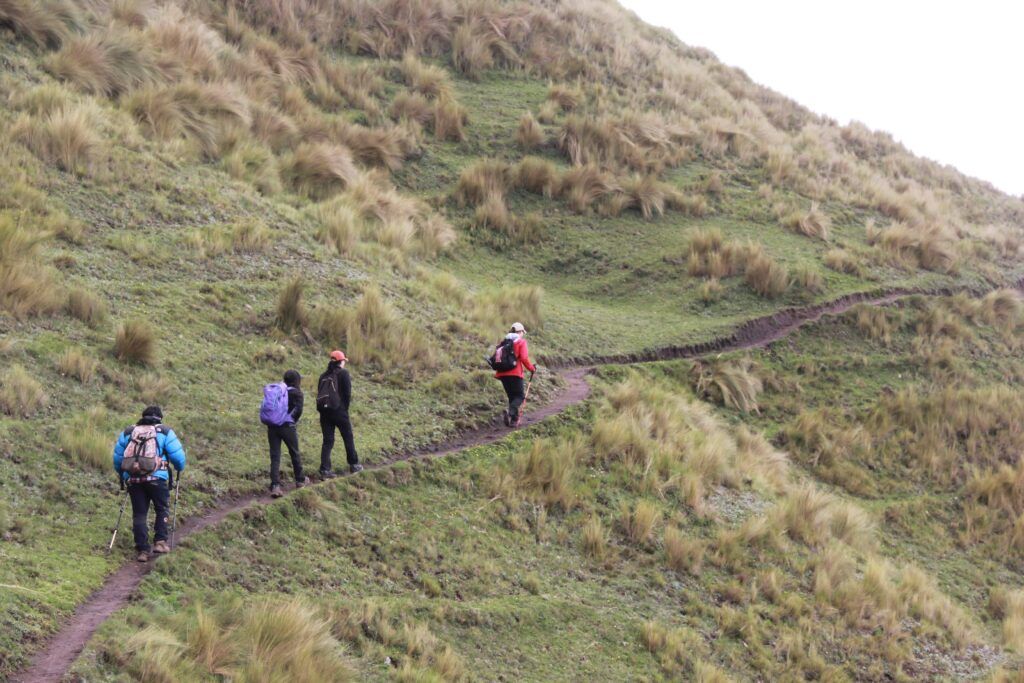
Finally, there’s the scenery. This trek takes you from the dry high-altitude puna, with views of the snow-capped Verónica peak, down to greener valleys near Ollantaytambo, offering a diversity of landscapes, climates, and ecosystems that few routes in the region can match in just four days.
Day 1: Cusco – Socma – Rayán
Distance: 8–12 km | Altitude: 3,205 m to 3,700 m | Duration: 4–5 hours of walking | Difficulty: Moderate
The adventure begins early in the morning with pickup from your hotel in Cusco. We travel by private vehicle for approximately two hours to the community of Socma (3,205 m), the starting point of the trek and, on some itineraries, the place where the horses and horsemen who accompany the group join the expedition.
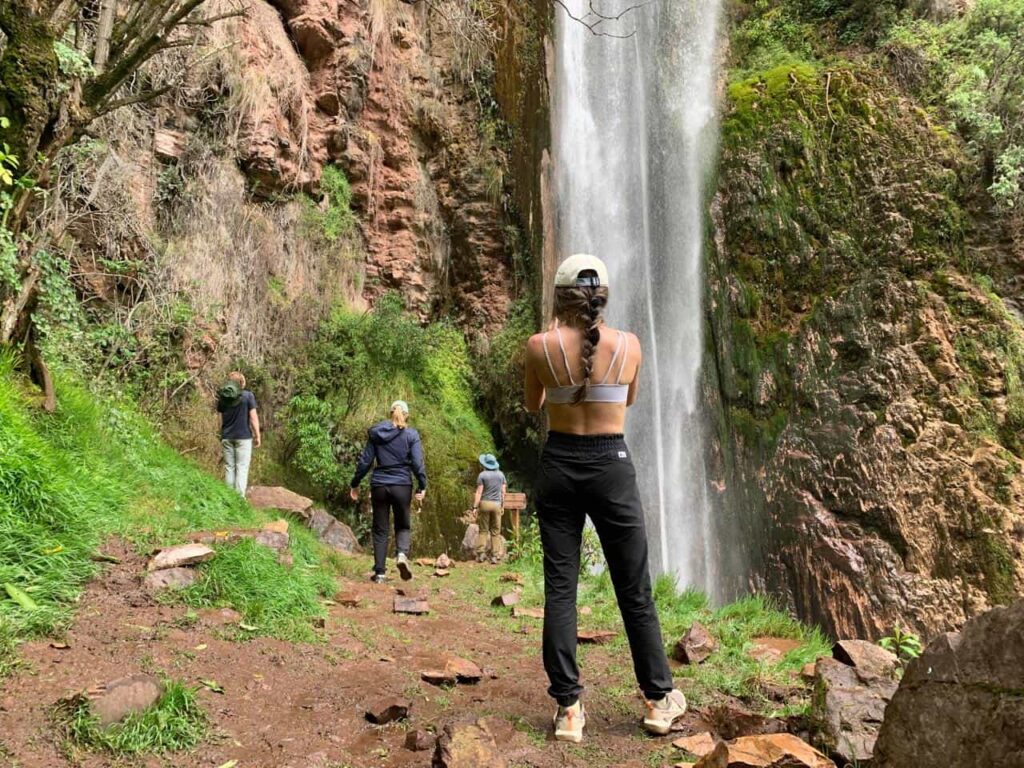
From Socma, a roughly 1-hour-45-minute trail leads to the viewpoint of the Perolniyoc waterfall (3,460 m), a nearly 100-meter cascade considered one of the most impressive in the Cusco region. From this point you’ll enjoy privileged views of the Soqma valley, the Maras plateau, and the snow-capped mountains on the horizon. It’s a mandatory stop for photos and a short rest.
After another 35 minutes on the trail, we reach the Perolniyoc archaeological site, also known as Raqaypata, where we’ll have a brief guided visit before stopping for lunch. With renewed energy, we ascend for about 45 minutes to the campsite at Rayán (3,700 m), where we’ll spend our first night under a star-filled high-altitude sky.
Tip: this first day is relatively accessible in terms of physical effort, so use it to acclimatize without overexerting yourself. Stay well hydrated and avoid alcohol the night before starting the trek: day two is, by far, the most demanding of the entire route.
Day 2: Rayán – Charkahuaylla Pass – Inti Punku – Cachicata
Distance: 12–14 km | Maximum altitude: 4,450 m (Charkahuaylla Pass) | Duration: 6–7 hours | Difficulty: Challenging
This is the hardest day and, at the same time, the most spectacular of the route. After a hearty breakfast, we begin the ascent toward the Charkahuaylla Pass, the highest point of the entire trek, at 4,450 meters above sea level. It’s a demanding stretch, but the views make every step worthwhile: from here you’ll have a front-row view of Verónica peak (Wakay Willca, 5,893 m), one of the most imposing sacred mountains in the Sacred Valley, its white silhouette dominating the landscape at several points along the trek.
We continue descending toward Inti Punku, this route’s own «Sun Gate» — distinct from the one found on the classic Inca Trail into Machu Picchu — located at 3,886 meters. From this natural viewpoint you can take in a wide panorama of the valley and the surrounding snow peaks.
After a trailside lunch, we descend through a canyon to reach the Cachicata Quarries (between 3,525 and 3,820 m), the archaeological and historical heart of this trek. This site, located about 14 km from Ollantaytambo, was one of the main sources of the pink granite used to build the Inca structures of that town. The area includes three extraction sectors — Molle Pucro, Sirkusirkuyoc, and Cachicata or Kantirayoq — and it’s still possible to see half-carved stone blocks and work platforms that testify to the remarkable level of Inca engineering and organization.
After exploring the site, we descend for about 40 minutes to the campsite where we’ll spend our second night, ideal for stargazing thanks to the altitude and the near-total absence of light pollution.
Tip: bring warm clothing for the night, as temperatures drop significantly above 3,700 meters, and don’t forget your trekking poles — they’ll help enormously both on the ascent to the pass and on the technical descents of this day.
Day 3: Cachicata – Ollantaytambo – Machu Picchu Pueblo
Distance: 8–10 km of walking | Altitude: descending from 3,700 m to 2,700 m | Difficulty: Moderate
After breakfast, we begin the descent toward Ollantaytambo (2,700 m), one of the few Inca towns that has been continuously inhabited since pre-Hispanic times, still preserving its original urban layout and water channels. Here you’ll have the chance to explore the imposing fortress-temple, with its agricultural terraces and enormous stone blocks brought precisely from the quarries we visited the day before.
Many travelers take this stop as an opportunity to relax in the hot springs near town before continuing the journey. In the afternoon, we board the panoramic train to Aguas Calientes, also known as Machu Picchu Pueblo (2,050 m), where we’ll spend the last night of the trek, now at a hotel with all the comforts.
Tip: Ollantaytambo is an excellent place to buy textiles and local handicrafts at fairer prices than in the more touristy areas closer to Machu Picchu.
Day 4: Machu Picchu – Cusco
Machu Picchu altitude: 2,400 m | Guided tour duration: approximately 2 hours
The final day starts early with an energizing breakfast before boarding the tourist bus that climbs up to the citadel. With a guided tour of approximately two hours, we’ll explore the main sectors of Machu Picchu: the agricultural sector, the urban sector, and the ceremonial temples, including the Temple of the Sun and the Intihuatana stone, believed to have served as a solar clock and astronomical calendar for the Incas.
After the guided visit, you’ll have free time to explore on your own, take photos from the different viewpoints, or simply sit and take in the citadel in silence. After lunch in Aguas Calientes, we head to the train station to return to Ollantaytambo, and from there by ground transport back to Cusco, where you’ll be dropped off directly at your hotel, closing out this four-day adventure.
Key Route Data
| Feature | Detail |
|---|---|
| Total duration | 4 days / 3 nights |
| Approximate distance | 30–35 km of walking |
| Maximum altitude | 4,450 m (Charkahuaylla Pass) |
| Minimum altitude | 2,050 m (Aguas Calientes) |
| Overall difficulty | Moderate to challenging |
| Accommodation | Camping (days 1 and 2), hotel/hostel (day 3) |
| Group departures | Daily, no permit or quota required |
What to Pack: Recommended Gear List
- Trekking backpack (30–40 liters) plus a small daypack
- Waterproof, already broken-in trekking boots
- Layered clothing: thermal base layer, insulating mid-layer, and a waterproof jacket
- Warm hat and gloves for high-altitude nights
- Sun hat or cap and high-SPF sunscreen (UV radiation is intense above 3,000 m)
- Trekking poles, especially useful for the Charkahuaylla Pass
- Headlamp, reusable water bottle or hydration system, and energy snacks
- Insect repellent for the lower stretches near Aguas Calientes
Tips for Your Trek
- Prior acclimatization: Spend at least two full days in Cusco (3,400 m) before starting the trek to let your body adjust to the altitude.
- Hydration and altitude sickness: Drink plenty of water throughout the trek and consider coca tea, widely used locally to ease the symptoms of altitude sickness (soroche).
- Best time to travel: The dry season, between May and September, offers clear skies, better trail conditions, and ideal nights for stargazing — though it’s also the region’s busiest tourist season.
- Recommended fitness level: A medium-to-high level of physical fitness is recommended, since day two involves a steep, sustained climb up to 4,450 meters.
- Fewer crowds, same magic: Unlike the classic Inca Trail, this route doesn’t require booking months in advance or competing for limited permits, making it ideal for travelers with more flexible plans.
- Respect for local communities: The trek passes through Andean communities such as Socma; it’s recommended to carry cash in Peruvian soles for small purchases and to always maintain a respectful attitude toward local residents.
A perfect alternative for those seeking the magic of Machu Picchu without the crowds of the classic Inca Trail, combining history, little-explored archaeology, and high-altitude Andean landscapes in an unforgettable four-day journey


